Matteo Nulli , Vladimir Orshulevich, Tala Bazazo, Christian Herold, Michael Kozielski, Marcin Mazur, Szymon Tuzel, Cees G. M. Snoek, Seyyed Hadi Hashemi, Omar Javed, Yannick Versley, Shahram Khadivi eBay, University of Amsterdam Accepted to EACL 2026 Industry Track
Motivation If you’ve ever shopped online for something even mildly specific—say, a “navy waterproof trail running jacket with taped seams”—you already know the problem: product understanding isn’t just text. It’s photos. It’s packaging. It’s messy seller-generated descriptions. It’s half-structured attributes that sometimes help and often don’t. And it’s usually multiple images that each reveal different parts of the truth.
E-commerce product understanding is, by nature, deeply multimodal .
Yet most production shopping systems still lean heavily on text matching—titles, short descriptions, maybe a few extracted specs—because it’s reliable, scalable, and easy to index. The issue is that customers don’t shop that way. People compare photos for color, texture, size cues, labels, logos, and packaging details, and then reconcile what they saw with whatever the listing claims.
Meanwhile, the model landscape has changed fast. Large Language Models have started showing strong performance on e-commerce tasks, especially when you tailor them to the domain—either through adaptation strategies or domain-aware training recipes (1 , 2 , 3 , 4 ). But translating that success into the vision–language setting is not automatic—and that gap is exactly what this work is about.
Figure 1: Output of our E-commerce Adapted VLMs compared against same size LLaVA-OneVision. We show our models ability to more faithfully extract attributes from e-commerce items. In red, we highlight wrong model predictions that are neither tied to the image nor valid item attributes.
General-purpose Vision–Language Models (VLMs) have reached a point where multimodal assistants are finally practical. Modern models can jointly reason over images and text, follow instructions, and generalize across tasks, building on strong vision and language backbones (5 , 6 ). Recent families—such as LLaVA and its successors (7 , 9 , 10 ), Qwen3-VL (11 ), InternVL4 (12 ), and Gemma3 (13 )—demonstrate how quickly the field is advancing. However, e-commerce remains a difficult target. Shopping scenarios demand attribute-centric reasoning, aggregation across multiple images, robustness to noisy seller content, and strict instruction following—requirements that go well beyond standard captioning or VQA. While multimodal benchmarks exist (15 , 16 , 17 ), they only partially capture these shopping-specific challenges.
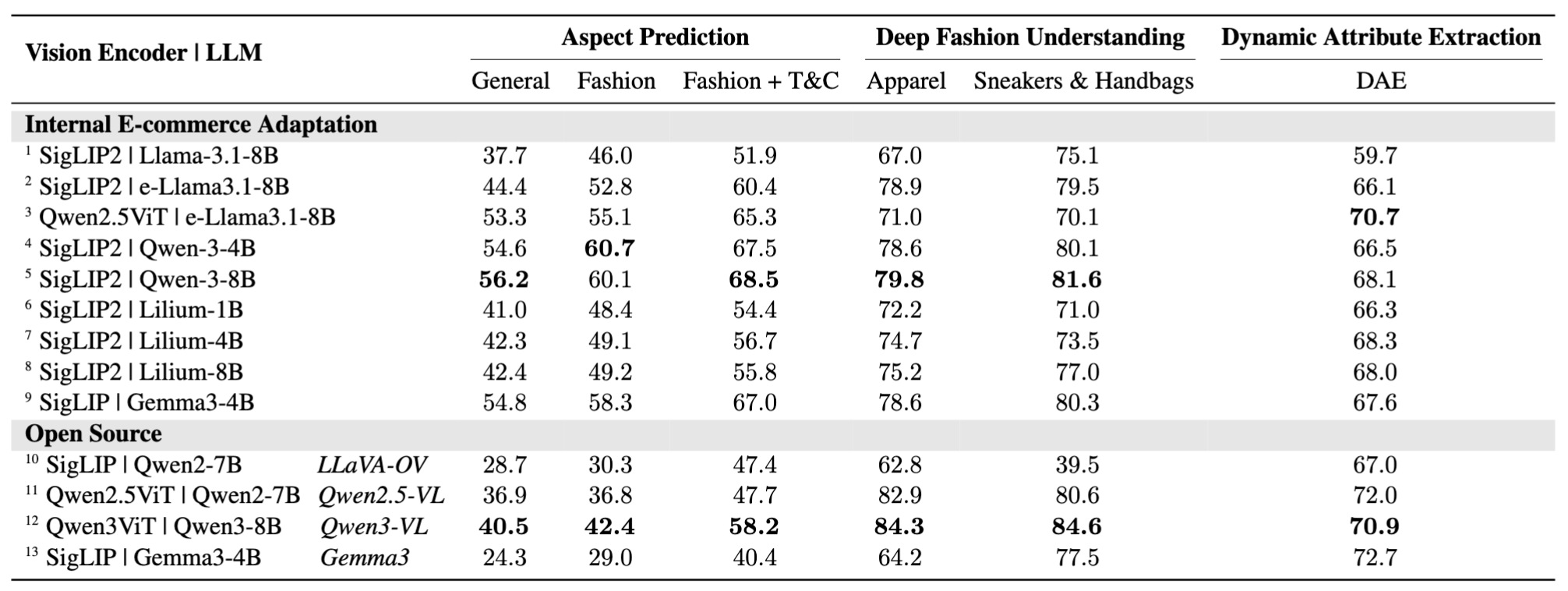
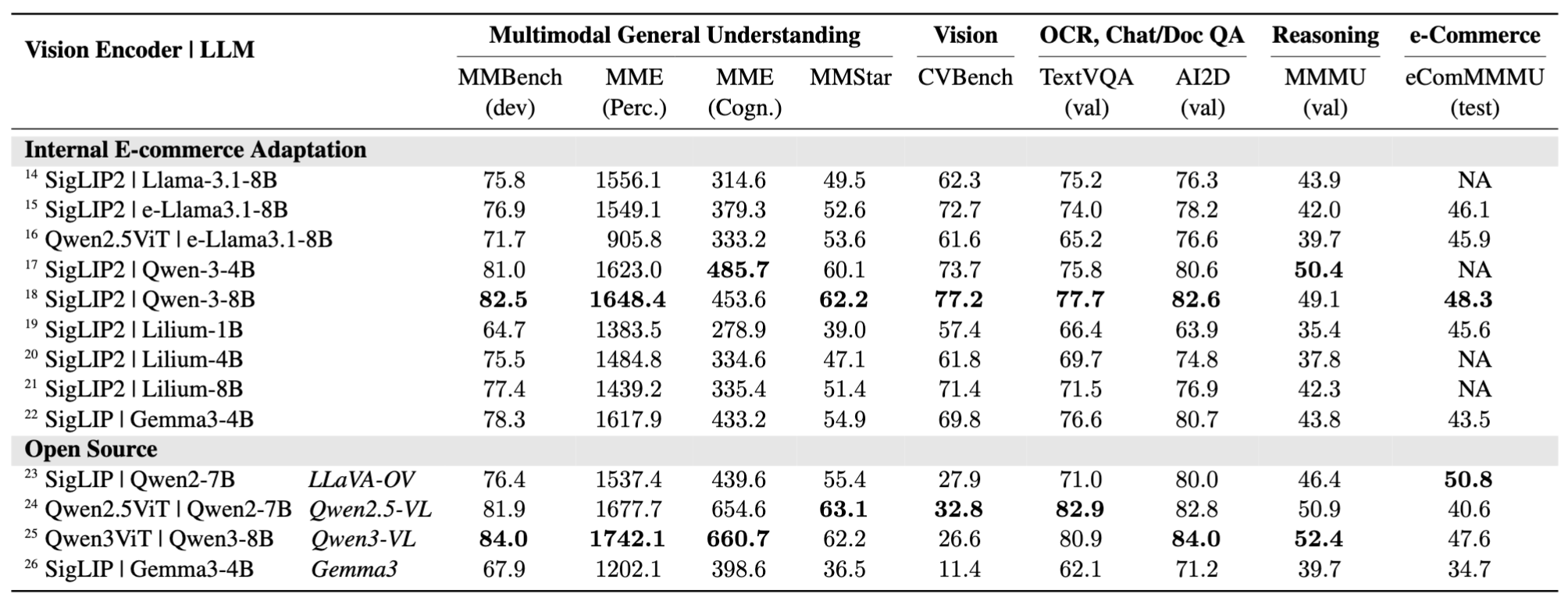
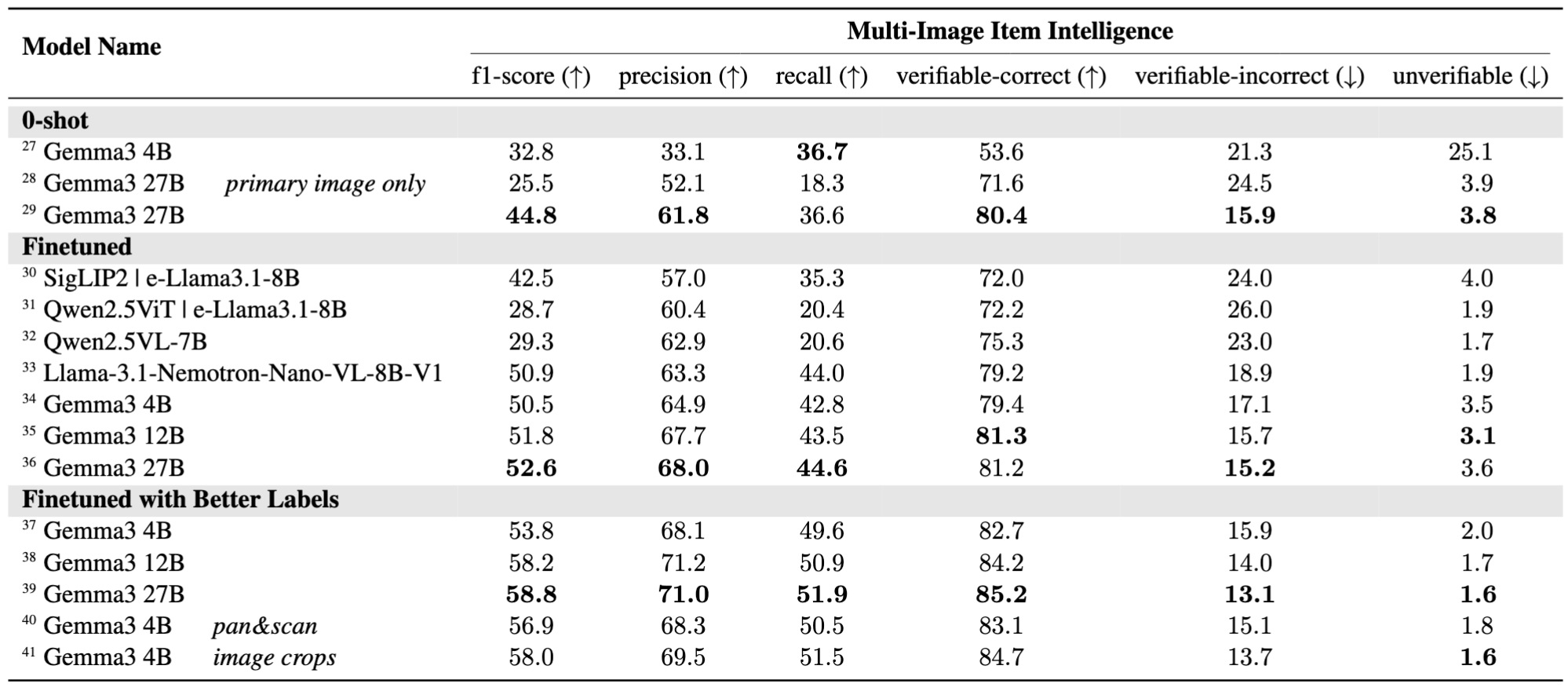
We study whether strong e-commerce performance truly requires a custom language model, or whether targeted adaptation of vision components is sufficient. Through extensive ablations across different visual and text decoders, combined with efficient adaptation techniques such as low-rank updates (22 ), we show that careful multimodal adaptation can yield substantial gains. In parallel, we introduce a new evaluation suite designed around real online retail use-cases. It emphasizes deep product understanding, strict instruction following, and multi-image reasoning—dimensions that are underrepresented in existing benchmarks.
Our main finding is simple: general-purpose VLMs can be effectively adapted to e-commerce with targeted, reproducible strategies that preserve broad multimodal competence . This enables meaningful improvements on shopping tasks without sacrificing performance in other domains, and provides a clearer path toward realistic multimodal shopping assistants.
Methodology Figure 3:
Results Figure 3:
Figure 4:
Figure 5:
Citation If you use this work, please cite:
@inproceedings{nulli2025objectguided,
title={Object-Guided Visual Tokens: Eliciting Compositional Reasoning in Multimodal Language Models},
author={Matteo Nulli and Ivona Najdenkoska and Mohammad Mahdi Derakhshani and Yuki M Asano},
booktitle={EurIPS 2025 Workshop on Principles of Generative Modeling (PriGM)},
year={2025},
url={https://openreview.net/forum?id=yvY1T3hHEQ}
}
References
Huang Irene, Lin Wei, Mirza M. Jehanzeb, Hansen Jacob A., Doveh Sivan, Butoi Victor Ion, Herzig Roei, Arbelle Assaf, Kuehne Hilde, Darrell Trevor, Gan Chuang, Oliva Aude, Feris Rogerio, Karlinsky Leonid. (2024). Conme: Rethinking Evaluation of Compositional Reasoning for Modern VLMs. arXiv preprint arXiv:2406.08164.
Tong Shengbang, Liu Zhuang, Zhai Yuexiang, Ma Yi, LeCun Yann, Xie Saining. (2024). Eyes Wide Shut? Exploring the Visual Shortcomings of Multimodal LLMs. arXiv preprint arXiv:2401.06209.
Liu Haotian, Li Chunyuan, Wu Qingyang, Lee Yong Jae. (2023). Visual Instruction Tuning. arXiv preprint arXiv:2304.08485.
Bo Li, Yuanhan Zhang, Dong Guo, Renrui Zhang, Feng Li, Hao Zhang, Kaichen Zhang, Peiyuan Zhang, Yanwei Li, Ziwei Liu, and Chunyuan Li. 2024a. Llava-onevision: Easy visual task transfer. Preprint, arXiv:2408.03326.
Bai Shuai, Chen Keqin, Liu Xuejing, Wang Jialin, Ge Wenbin, Song Sibo, Dang Kai, Wang Peng, Wang Shijie, Tang Jun, Zhong Humen, Zhu Yuanzhi, Yang Mingkun, Li Zhaohai, Wan Jianqiang, Wang Pengfei, Ding Wei, Fu Zheren, Xu Yiheng, Ye Jiabo, Zhang Xi, Xie Tianbao, Cheng Zesen, Zhang Hang, Yang Zhibo, Xu Haiyang, Lin Junyang. (2025). Qwen2.5-VL Technical Report. arXiv preprint arXiv:2502.13923.
OpenGVLab-Team. (2024). InternVL2: Better Than the Best—Expanding Performance Boundaries of Open-Source Multimodal Models with the Progressive Scaling Strategy. Blog post. URL https://internvl.github.io/blog/2024-07-02-InternVL-2.0/.
Gemma-Team. (2025). Gemma 3 Technical Report. arXiv preprint arXiv:2503.19786.
Yuksekgonul Mert, Bianchi Federico, Kalluri Pratyusha, Jurafsky Dan, Zou James. (2023). When and Why Vision-Language Models Behave Like Bags-of-Words, and What to Do About It? arXiv preprint arXiv:2210.01936.
Nulli Matteo, Ibrahimi Anesa, Pal Avik, Lee Hoshe, Najdenkoska Ivona. (2024). In-Context Learning Improves Compositional Understanding of Vision-Language Models. In ICML 2024 Workshop on Foundation Models in the Wild. arXiv preprint arXiv:2407.15487.
Awal Rabiul, Ahmadi Saba, Zhang Le, Agrawal Aishwarya. (2025). Vismin: Visual Minimal-Change Understanding. arXiv preprint arXiv:2407.16772.
Tong Shengbang, Brown Ellis, Wu Penghao, Woo Sanghyun, Middepogu Manoj, Akula Sai Charitha, Yang Jihan, Yang Shusheng, Iyer Adithya, Pan Xichen, Wang Austin, Fergus Rob, LeCun Yann, Xie Saining. (2024). Cambrian-1: A Fully Open, Vision-Centric Exploration of Multimodal LLMs. arXiv preprint arXiv:2406.16860.
Liu Haotian, Li Chunyuan, Li Yuheng, Li Bo, Zhang Yuanhan, Shen Sheng, Lee Yong Jae. (2024). LLaVA-NeXT: Improved Reasoning, OCR, and World Knowledge. Blog post (January 2024). URL https://llava-vl.github.io/blog/2024-01-30-llava-next/.
Ravi Nikhila, Gabeur Valentin, Hu Yuan-Ting, Hu Ronghang, Ryali Chaitanya, Ma Tengyu, Khedr Haitham, Rädle Roman, Rolland Chloe, Gustafson Laura, Mintun Eric, Pan Junting, Alwala Kalyan Vasudev, Carion Nicolas, Wu Chao-Yuan, Girshick Ross, Dollár Piotr, Feichtenhofer Christoph. (2024). SAM 2: Segment Anything in Images and Videos. arXiv preprint arXiv:2408.00714.
Li Xiangtai, Yuan Haobo, Li Wei, Ding Henghui, Wu Size, Zhang Wenwei, Li Yining, Chen Kai, Loy Chen Change. (2024). OMG-Seg: Is One Model Good Enough for All Segmentation? In Proceedings of the IEEE/CVF Conference on Computer Vision and Pattern Recognition (CVPR), pages 27948–27959.
Chen Guo, Li Zhiqi, Wang Shihao, Jiang Jindong, Liu Yicheng, Lu Lidong, Huang De-An, Byeon Wonmin, Le Matthieu, Rintamaki Tuomas, Poon Tyler, Ehrlich Max, Lu Tong, Wang Limin, Catanzaro Bryan, Kautz Jan, Tao Andrew, Yu Zhiding, Liu Guilin. (2025). EAGLE 2.5: Boosting Long-Context Post-Training for Frontier Vision-Language Models. arXiv preprint arXiv:2504.15271.
Zhang Tao, Li Xiangtai, Fei Hao, Yuan Haobo, Wu Shengqiong, Ji Shunping, Loy Chen Change, Yan Shuicheng. (2024). OMG-LLaVA: Bridging Image-Level, Object-Level, Pixel-Level Reasoning and Understanding. arXiv preprint arXiv:2406.19389.
Yuan Haobo, Li Xiangtai, Zhang Tao, Huang Zilong, Xu Shilin, Ji Shunping, Tong Yunhai, Qi Lu, Feng Jiashi, Yang Ming-Hsuan. (2025). SA2VA: Marrying SAM2 with LLaVA for Dense Grounded Understanding of Images and Videos. arXiv preprint arXiv:2501.04001.
Radford Alec, Kim Jong Wook, Hallacy Chris, Ramesh Aditya, Goh Gabriel, Agarwal Sandhini, Sastry Girish, Askell Amanda, Mishkin Pamela, Clark Jack, Krueger Gretchen, Sutskever Ilya. (2021). Learning Transferable Visual Models from Natural Language Supervision. arXiv preprint arXiv:2103.00020.
Liu Haotian, Li Chunyuan, Li Yuheng, Lee Yong Jae. (2024). Improved Baselines with Visual Instruction Tuning. arXiv preprint arXiv:2310.03744.
Dosovitskiy Alexey, Beyer Lucas, Kolesnikov Alexander, Weissenborn Dirk, Zhai Xiaohua, Unterthiner Thomas, Dehghani Mostafa, Minderer Matthias, Heigold Georg, Gelly Sylvain, Uszkoreit Jakob, Houlsby Neil. (2021). An Image is Worth 16x16 Words: Transformers for Image Recognition at Scale. arXiv preprint arXiv:2010.11929.
Touvron Hugo, Martin Louis, Stone Kevin, Albert Peter, Almahairi Amjad, Babaei Yasmine, Bashlykov Nikolay, Batra Soumya, Bhargava Prajjwal, Bhosale Shruti, Bikel Dan, Blecher Lukas, Canton Ferrer Cristian, Chen Moya, Cucurull Guillem, Esiobu David, Fernandes Jude, Fu Jeremy, Fu Wenyin, Fuller Brian, Gao Cynthia, Goswami Vedanuj, Goyal Naman, Hartshorn Anthony, Hosseini Saghar, Hou Rui, Inan Hakan, Kardas Marcin, Kerkez Viktor, Khabsa Madian, Kloumann Isabel, Korenev Artem, Koura Punit Singh, Lachaux Marie-Anne, Lavril Thibaut, Lee Jenya, Liskovich Diana, Lu Yinghai, Mao Yuning, Martinet Xavier, Mihaylov Todor, Mishra Pushkar, Molybog Igor, Nie Yixin, Poulton Andrew, Reizenstein Jeremy, Rungta Rashi, Saladi Kalyan, Schelten Alan, Silva Ruan, Smith Eric Michael, Subramanian Ranjan, Tan Xiao-qing Ellen, Tang Binh, Taylor Ross, Williams Adina, Kuan Jian Xiang, Xu Puxin, Yan Zheng, Zarov Iliyan, Zhang Yuchen, Fan Angela, Kambadur Melanie, Narang Sharan, Rodriguez Aurelien, Stojnic Robert, Edunov Sergey, Scialom Thomas. (2023). Llama 2: Open Foundation and Fine-Tuned Chat Models.
Meta. (2024). Llama 3.2: Revolutionizing Edge AI and Vision with Open, Customizable Models. Blog post. URL https://ai.meta.com/blog/llama-3-2-connect-2024-vision-edge-mobile-devices/.
Hu Edward J., Shen Yelong, Wallis Phillip, Allen-Zhu Zeyuan, Li Yuanzhi, Wang Shean, Wang Lu, Chen Weizhu. (2021). LoRA: Low-Rank Adaptation of Large Language Models. arXiv preprint arXiv:2106.09685.
Lin Tsung-Yi, Maire Michael, Belongie Serge, Hays James, Perona Pietro, Ramanan Deva, Dollár Piotr, Zitnick C. Lawrence. (2014). Microsoft COCO: Common Objects in Context. In Computer Vision – ECCV 2014, pages 740–755. Springer.
Young Peter, Lai Alice, Hodosh Micah, Hockenmaier Julia. (2014). From Image Descriptions to Visual Denotations: New Similarity Metrics for Semantic Inference Over Event Descriptions. Transactions of the Association for Computational Linguistics, 2:67–78.
Krishna Ranjay, Zhu Yuke, Groth Oliver, Johnson Justin, Hata Kenji, Kravitz Joshua, Chen Stephanie, Kalantidis Yannis, Li Li-Jia, Shamma David A., et al. (2017). Visual Genome: Connecting Language and Vision Using Crowdsourced Dense Image Annotations. International Journal of Computer Vision, 123:32–73.
Hudson Drew A., Manning Christopher D. (2019). GQA: A New Dataset for Real-World Visual Reasoning and Compositional Question Answering. In Proceedings of the IEEE/CVF Conference on Computer Vision and Pattern Recognition (CVPR), pages 6700–6709.
Hsieh Cheng-Yu, Zhang Jieyu, Ma Zixian, Kembhavi Aniruddha, Krishna Ranjay. (2023). SugarCrepe: Fixing Hackable Benchmarks for Vision-Language Compositionality. Advances in Neural Information Processing Systems, 36:31096–31116.
OpenAI. (2024). GPT-4 Technical Report. arXiv preprint arXiv:2303.08774.
Chung Hyung Won, Hou Le, Longpre Shayne, Zoph Barret, Tay Yi, Fedus William, Li Yunxuan, Wang Xuezhi, Dehghani Mostafa, Brahma Siddhartha, et al. (2024). Scaling Instruction-Finetuned Language Models. Journal of Machine Learning Research, 25(70):1–53.
Kembhavi Aniruddha, Salvato Mike, Kolve Eric, Seo Minjoon, Hajishirzi Hannaneh, Farhadi Ali. (2016). A Diagram is Worth a Dozen Images. arXiv preprint arXiv:1603.07396.
Fu Chaoyou, Chen Peixian, Shen Yunhang, Qin Yulei, Zhang Mengdan, Lin Xu, Yang Jinrui, Zheng Xiawu, Li Ke, Sun Xing, Wu Yunsheng, Ji Rongrong. (2024). MME: A Comprehensive Evaluation Benchmark for Multimodal Large Language Models. arXiv preprint arXiv:2306.13394.
Chen Lin, Li Jinsong, Dong Xiaoyi, Zhang Pan, Zang Yuhang, Chen Zehui, Duan Haodong, Wang Jiaqi, Qiao Yu, Lin Dahua, Zhao Feng. (2024). Are We on the Right Way for Evaluating Large Vision-Language Models? arXiv preprint arXiv:2403.20330.
Liu Yuan, Duan Haodong, Zhang Yuanhan, Li Bo, Zhang Songyang, Zhao Wangbo, Yuan Yike, Wang Jiaqi, He Conghui, Liu Ziwei, Chen Kai, Lin Dahua. (2024). MMBench: Is Your Multi-Modal Model an All-Around Player? arXiv preprint arXiv:2307.06281.
Chen Delong, Cahyawijaya Samuel, Liu Jianfeng, Wang Baoyuan, Fung Pascale. (2025). Subobject-Level Image Tokenization. arXiv preprint arXiv:2402.14327.
Rasley Jeff, Rajbhandari Samyam, Ruwase Olatunji, He Yuxiong. (2020). DeepSpeed: System Optimizations Enable Training Deep Learning Models with Over 100 Billion Parameters. In Proceedings of the 26th ACM SIGKDD International Conference on Knowledge Discovery & Data Mining (KDD ’20), pages 3505–3506. doi:10.1145/3394486.3406703.
Rajbhandari Samyam, Rasley Jeff, Ruwase Olatunji, He Yuxiong. (2020). ZeRO: Memory Optimizations Toward Training Trillion Parameter Models. In SC20: International Conference for High Performance Computing, Networking, Storage and Analysis, pages 1–16. doi:10.1109/SC41405.2020.00024.
Kingma Diederik P., Ba Jimmy. (2017). Adam: A Method for Stochastic Optimization. arXiv preprint arXiv:1412.6980.
Loshchilov Ilya, Hutter Frank. (2019). Decoupled Weight Decay Regularization. arXiv preprint arXiv:1711.05101.
Devlin Jacob, Chang Ming-Wei, Lee Kenton, Toutanova Kristina. (2019). BERT: Pre-Training of Deep Bidirectional Transformers for Language Understanding. In Proceedings of NAACL-HLT 2019, pages 4171–4186.
Vaswani Ashish, Shazeer Noam, Parmar Niki, Uszkoreit Jakob, Jones Llion, Gomez Aidan N., Kaiser Łukasz, Polosukhin Illia. (2017). Attention Is All You Need. Advances in Neural Information Processing Systems, 30.
Agrawal Pravesh, Antoniak Szymon, Bou Hanna Emma, Bout Baptiste, Chaplot Devendra, Chudnovsky Jessica, Costa Diogo, De Monicault Baudouin, Garg Saurabh, Gervet Theophile, Ghosh Soham, Héliou Amélie, Jacob Paul, Jiang Albert Q., Khandelwal Kartik, Lacroix Timothée, Lample Guillaume, Las Casas Diego, Lavril Thibaut, Le Scao Teven, Lo Andy, Marshall Louis, Martin Arthur, Mensch Arthur, Muddireddy Pavankumar, Nemychnikova Valera, Pellat Marie, Von Platen Patrick, Raghuraman Nikhil, Bout Rozière Baptiste, Sablayrolles Alexandre, Saulnier Lucile, Sauvestre Romain, Rozière Baptiste, Shang Wendy, Soletskyi Roman, Stewart Lawrence, Stock Pierre, Studnia Joachim, Subramanian Sandeep, Vaze Sagar, Wang Thomas, Yang Sophia. (2024). Pixtral 12B. arXiv preprint arXiv:2410.07073.
Su Jianlin, Lu Yu, Pan Shengfeng, Murtadha Ahmed, Wen Bo, Liu Yunfeng. (2023). RoFormer: Enhanced Transformer with Rotary Position Embedding. arXiv preprint arXiv:2104.09864.
Dubey Abhimanyu, et al. (2024). The Llama 3 Herd of Models. arXiv preprint arXiv:2407.21783.
Cherti Mehdi, Beaumont Romain, Wightman Ross, Wortsman Mitchell, Ilharco Gabriel, Gordon Cade, Schuhmann Christoph, Schmidt Ludwig, Jitsev Jenia. (2023). Reproducible Scaling Laws for Contrastive Language-Image Learning. In 2023 IEEE/CVF Conference on Computer Vision and Pattern Recognition (CVPR), pages 2818–2829. doi:10.1109/CVPR52729.2023.00276.
Zhai Xiaohua, Mustafa Basil, Kolesnikov Alexander, Beyer Lucas. (2023). Sigmoid Loss for Language Image Pre-Training. arXiv preprint arXiv:2303.15343.
Oquab Maxime, Darcet Timothée, Moutakanni Théo, Vo Huy, Szafraniec Marc, Khalidov Vasil, Fernandez Pierre, Haziza Daniel, Massa Francisco, El-Nouby Alaaeldin, Assran Mahmoud, Ballas Nicolas, Galuba Wojciech, Misra Ishan, Rabbat Michael, Sharma Vasu, Synnaeve Gabriel, Xu Hu, Jegou Hervé, Mairal Julien, Labatut Patrick, Joulin Armand, Bojanowski Piotr. (2024). DINOv2: Learning Robust Visual Features Without Supervision. arXiv preprint arXiv:2304.07193.
Cai Zheng, Cao Maosong, Chen Haojiong, Chen Kai, Chen Keyu, Chen Xin, Chen Xun, Chen Zehui, Chen Zhi, Chu Pei, Dong Xiaoyi, Duan Haodong, Fan Qi, Fei Zhaoye, Gao Yang, Ge Jiaye, Gu Chenya, Gu Yuzhe, Gui Tao, Guo Aijia, Guo Qipeng, He Conghui, Hu Yingfan, Huang Ting, Jiang Tao, Jiao Penglong, Jin Zhenjiang, Lei Zhikai, Li Jiaxing, Li Jingwen, Li Linyang, Li Shuaibin, Li Wei, Li Yining, Liu Hongwei, Liu Jiawei, Liu Kaiwen, Liu Kuikun, Liu Xiaoran, Lv Chengqi, Lv Haijun, Lv Kai, Ma Li, Ma Runyuan, Ma Zerun, Ning Wenchang, Ouyang Linke, Qiu Jiantao, Qu Yuan, Shang Fukai, Shao Yunfan, Song Demin, Song Zifan, Sui Zhihao, Sun Peng, Sun Yu, Tang Huanze, Wang Bin, Wang Guoteng, Wang Jiaqi, Wang Jiayu, Wang Rui, Wang Yudong, Wang Ziyi, Wei Xingjian, Weng Qizhen, Wu Fan, Xiong Yingtong, Xu Chao, Xu Ruiliang, Yan Hang, Yan Yirong, Yang Xiaogui, Ye Haochen, Ying Huaiyuan, Yu Jia, Yu Jing, Zang Yuhang, Zhang Chuyu, Zhang Li, Zhang Pan, Zhang Peng, Zhang Ruijie, Zhang Shuo, Zhang Songyang, Zhang Wenjian, Zhang Wenwei, Zhang Xingcheng, Zhang Xinyue, Zhao Hui, Zhao Qian, Zhao Xiaomeng, Zhao Fengzhe, Zhou Zaida, Zhou Jingming, Zhuo Jingming, Zou Yicheng, Qiu Xipeng, Qiao Yu, Lin Dahua. (2024). InternLM2 Technical Report. arXiv preprint arXiv:2403.17297.
Li Xiangtai, Yuan Haobo, Li Wei, Ding Henghui, Wu Size, Zhang Wenwei, Li Yining, Chen Kai, Loy Chen Change. (2024). OMG-Seg: Is One Model Good Enough for All Segmentation? arXiv preprint arXiv:2401.10229.
Zou Xueyan, Yang Jianwei, Zhang Hao, Li Feng, Li Linjie, Wang Jianfeng, Wang Lijuan, Gao Jianfeng, Lee Yong Jae. (2023). Segment Everything Everywhere All at Once. arXiv preprint arXiv:2304.06718.